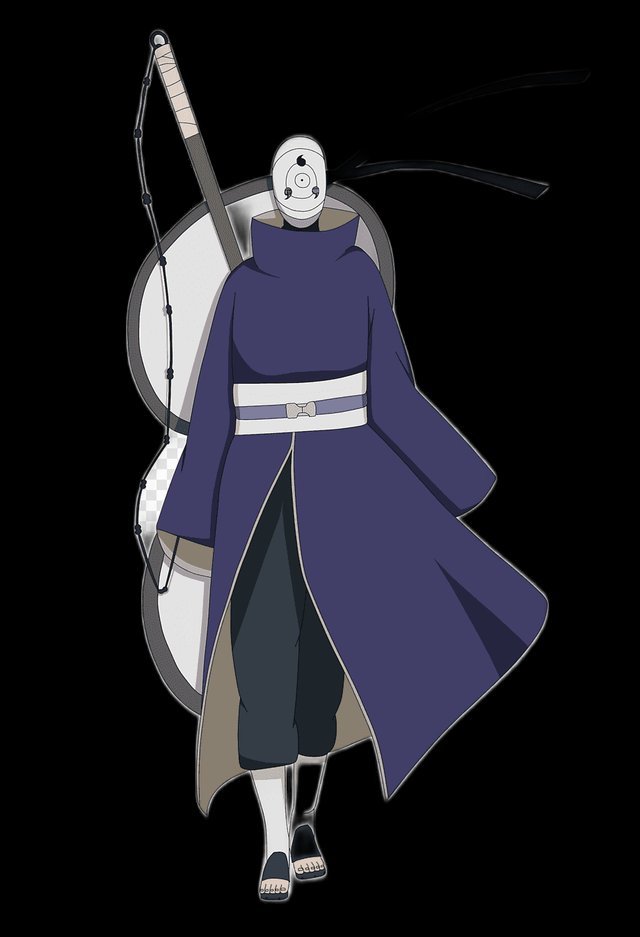
Kakashi's teammate presumed dead. Became the Ten-Tails Jinchuriki after orchestrating the Fourth Great Ninja War behind the mask as Tobi.
Akatsuki Puppeteer / Jinchuriki · Kakashi's teammate presumed dead.
Kakashi's teammate presumed dead. Became the Ten-Tails Jinchuriki after orchestrating the Fourth Great Ninja War behind the mask as Tobi.
Akatsuki Puppeteer / Jinchuriki · Kakashi's teammate presumed dead.
Obito Uchiha is among the most complex and influential characters in the Naruto series. First introduced as Kakashi Hatake's cheerful teammate who supposedly died during the Third Great Ninja War, Obito's story reaches into nearly every major event across the shinobi world. He survived the Kannabi Bridge mission, was rescued and rehabilitated by Madara Uchiha, witnessed Rin Nohara's death firsthand, and shattered into a nihilistic figure who waged war against the entire shinobi system.
For years Obito hid behind the mask and identity of Tobi, manipulating the Akatsuki from the shadows and orchestrating the Fourth Great Ninja War. After becoming the Ten-Tails Jinchuriki and fighting Naruto Uzumaki directly, Obito rediscovered his old ideals and sacrificed himself to help save the world he once tried to destroy. His arc spans the entire Naruto timeline, from Kakashi Gaiden to the war's final battle against Kaguya.
Obito's legacy is defined by duality — he was both the boy who taught Kakashi the value of comrades and the masked man who killed his own teacher, Minato Namikaze. His redemption remains the most debated topics in the Naruto fandom, precisely because his fall and recovery both feel earned within the story's logic.
As a young genin, Obito wore a standard Konoha uniform with a blue scarf, sandals, and goggles pushed up on his forehead. An orange fabric covering his lower face and his bright, round eyes gave him a distinctive look that matched his upbeat personality. His spiky black hair and short stature made him appear younger than his peers.
After the Kannabi Bridge incident, Madara rebuilt his crushed right body using White Zetsu cells. The right side of his face became pale and wrinkled, while his left side retained his original skin. As Tobi, he concealed this disfigurement behind an orange spiral mask with a single eyehole for his Sharingan. His Akatsuki cloak and broad build made him appear taller and more intimidating than his genin self. The orange mask became the most iconic visual symbols in the series.
When his mask finally broke during his confrontation with Konoha ninja, the world saw the scarred face beneath — half aged and wrinkled, half smooth from Zetsu tissue, with a single Sharingan eye visible. After fusing with the Ten-Tails, Obito transformed into a jinchuriki wielding Six Paths Sage powers. His body became pale white, his hair turned gray-white, and Truth-Seeking Balls floated behind him in a ring. A black staff and white chakra cloak completed the godlike form. In his final moments, the Six Paths form crumbled away, revealing the young face of the boy who once dreamed of being Hokage.
Young Obito was loud, enthusiastic, and endlessly optimistic. He showed up late constantly, complained about training, and struggled to keep up with Kakashi's genius. But beneath the immaturity lay an unshakable loyalty to his teammates. His defining childhood principle — never abandon your comrades — came from witnessing the consequences of Kakashi's father Sakumo Hatake's disgrace. Obito internalized this creed and passed it to Kakashi at Kannabi Bridge.
Rin Nohara's death destroyed this worldview entirely. The boy who believed in protecting everyone became a man who believed the world was beyond saving. As Tobi, Obito adopted a theatrical, playful persona that masked bottomless despair. His speech about a world where pain exists being a "hell" reflected genuine philosophical conviction, not mere villainy. He believed that trapping all humanity in an infinite genjutsu — the Tsukuyomi — was the kindest possible solution to suffering.
Obito's slow return to his original self came through Naruto Uzumaki, who refused to accept Obito as irredeemable. Their battle was not just physical but ideological — Naruto proved that connection and hope could overcome the despair that had consumed Obito. His redemption is messy and incomplete: he committed mass murder, killed innocents, and started a catastrophic war. Yet his final act of self-sacrifice showed that his childhood heart still existed beneath decades of pain.
Obito's Sharingan awakened at age 11 during the Kannabi Bridge mission, triggered by his determination to save Kakashi and Rin from enemy ninja. He progressed to Mangekyo Sharingan immediately after witnessing Rin's death at Kakashi's hand, unlocking the most hax abilities in the series: Kamui.
Kamui. This Mangekyo ability manifests differently in each eye. Obito's right eye grants passive intangibility — he can phase any part of his body through attacks by sending the struck portion into a pocket dimension. This makes him virtually immune to physical damage as long as he maintains the technique. Kakashi's left eye (originally Obito's gift) enables long-range teleportation, pulling targets into the same dimension from a distance. Both eyes share a linked dimensional space. Obito could maintain intangibility for five continuous minutes, a limit he exploited in battle.
Wood Style. The Hashirama cells Madara used to rebuild Obito's body granted him Wood Style release, the rare kekkei genkai combining Earth and Water natures. Wood Style allowed Obito to control tailed beasts, create massive constructs, and suppress bijuu chakra. He used it to control the Nine-Tails during the Konoha attack and to restrain tailed beasts during the Fourth War.
Six Paths and Ten-Tails Powers. After absorbing the Ten-Tails, Obito gained Six Paths Sage Mode, Truth-Seeking Balls, flight, regeneration, and the Six-Red Yata no Kagami barrier. This barrier could withstand attacks from the combined allied shinobi forces. He also wielded the Gunbai war fan, inherited from Madara, which could absorb and reflect chakra-based attacks. His physical speed and reflexes were sharp enough to challenge Minato Namikaze, the legendary Yellow Flash.
As a genin under Minato Namikaze, Obito served alongside Kakashi Hatake and Rin Nohara. During the Kannabi Bridge mission in the Third Great Ninja War, Kakashi was wounded protecting Rin. When enemy ninja cornered them, Obito awakened his Sharingan, realized Kakashi had prioritized the mission over saving Rin, and charged in to rescue her despite the odds. A massive boulder crushed the right side of his body in the process. Believing he was dying, he gave his left Sharingan to Kakashi as a gift for becoming jonin. His last words — "Those who abandon their comrades are worse than trash" — became the series' central theme.
Madara Uchiha, secretly alive in an underground cavern, found Obito's broken body and rebuilt it using White Zetsu cells. Obito spent months in rehabilitation, during which Madara indoctrinated him with the Uchiha stone tablet's twisted history and the Eye of the Moon Plan. When Obito finally emerged, he witnessed Rin being killed by Kakashi's Chidori — a trap set by Kirigakure to unleash the Three-Tails on Konoha. This traumatic sight activated his Mangekyo Sharingan on the spot. He killed the Kirigakure ninja, rescued Kakashi, and declared the shinobi world beyond saving.
Adopting the name Tobi and wearing the orange spiral mask, Obito approached the original Akatsuki as Madara's representative. After Yahiko's death and Nagato's transformation into Pain, Obito guided the Akatsuki from the shadows. He recruited Deidara, Kisame, and Itachi. He placed Yagura Karatachi, the Fourth Mizukage, under genjutsu control, throwing Kirigakure into its brutal Bloody Mist era for years. He orchestrated the Nine-Tails attack on Konoha the night Naruto was born, resulting in Minato and Kushina's deaths. He groomed Sasuke Uchiha as a weapon for his plans, manipulating events to drive Sasuke toward hatred and power.
Obito publicly declared the Fourth Great Ninja War at the Five Kage Summit, revealing himself as the masked leader behind the curtain. He allied with Kabuto Yakushi's Edo Tensei army and revived the Ten-Tails. After becoming the Ten-Tails Jinchuriki, Obito fought Naruto, Sasuke, and the allied shinobi forces. Naruto's refusal to hate him and his ability to see through Obito's pain slowly reached the broken man within. When Black Zetsu betrayed him to resurrect Kaguya, Obito realized he had been manipulated his entire life — by Madara, by Black Zetsu, by the stone tablet's fabricated history. In his final act, Obito saved Naruto from Kaguya's attack, used Kamui to help retrieve Sasuke from another dimension, and passed his remaining Six Paths powers to Kakashi. He died at peace, reunited with Rin in the afterlife, his original self restored.
Kakashi Hatake. Obito's rival, teammate, and best friend. Their relationship defines both characters across the entire series. Obito gave Kakashi his Sharingan and his creed about protecting comrades. They fought as enemies during the war — Kakashi forced to strike Obito's heart, Obito forcing Kakashi to relive Rin's death — but reconciled in Obito's final moments when Kakashi accepted his redeemed friend.
Rin Nohara. Obito's first and only love. Rin's death at Kakashi's hand shattered Obito's worldview and set him on the path to villainy. His final moments in the afterlife showed Rin waiting for him, suggesting their bond transcended even death. The Obito-Rin-Kakashi triangle is the emotional core of Kakashi Gaiden and the war arc.
Madara Uchiha. Obito's rescuer and greatest manipulator. Madara saved Obito's life to mold him into a successor who would execute the Eye of the Moon Plan. Obito spent decades believing he was acting on Madara's will, only to discover at the end that both he and Madara had been pawns of Black Zetsu.
Naruto Uzumaki. Obito's ideological mirror. Both were jinchuriki orphans who lost their parents to the Nine-Tails attack — an attack Obito himself caused. Naruto's refusal to give up on Obito, his ability to understand Obito's pain without excusing his crimes, was the key to Obito's redemption. Their fight was philosophical: Naruto proved that connection, not isolation, was the answer to suffering.
Minato Namikaze. Obito's teacher, who sensed familiarity in Tobi's fighting style but could not believe his dead student had survived. Obito killed Minato and Kushina during the Nine-Tails attack, then fought Minato's reanimated form during the war. Their confrontation was charged with the tragedy of what could have been.
Obito Uchiha's reveal as Tobi is widely considered one of the greatest plot twists in anime history. The moment his mask shattered, revealing Kakashi's Mangekyo Sharingan and half of Kakashi's face underneath, fundamentally changed how the entire series was understood. Fans rewatched every Tobi scene looking for clues, and the twist sparked endless debate about foreshadowing and narrative construction.
Kamui's intangibility and teleportation mechanics created some of the most creative and tense fight scenes in the series. The Kakashi Gaiden arc, focused on young Obito, remains the most beloved side stories in the Naruto franchise and is frequently recommended as essential reading even outside the main series. Obito's iconic lines — "In this world, wherever there is light, there are also shadows" and "The concept of hope is nothing more than giving up in a way that looks good" — are frequently quoted and memeified across anime communities.
Obito ranked high in multiple Shonen Jump popularity polls, consistently placing in the top 15 despite being a late-stage antagonist. His orange mask design is the most recognizable villain motifs in anime, frequently appearing in cosplay, merchandise, and fan art. The character's arc from idealistic child to genocidal villain to reluctant hero challenged the simple good-versus-evil framework typical of shonen manga, influencing how later series approached antagonist redemption.
The philosophical dimension of Obito's character — his argument that a world with pain is not worth living in, contrasted with Naruto's belief that pain gives meaning to connection — elevated Naruto's thematic depth and is cited by fans as one of the series' most mature discussions. The Obito-Kakashi-Rin love triangle and its tragic resolution continues to inspire fan fiction and analysis years after the series ended.
Kamui has two linked abilities tied to each Mangekyo eye. Obito's right eye grants intangibility — he phases his body through attacks by sending the struck part into a pocket dimension. Kakashi's left eye can teleport targets across long distances into the same dimension. Both eyes share a linked dimensional space. Obito can maintain intangibility for about five minutes before the technique wears off temporarily.
Using Madara's name gave Obito instant authority and fear across the shinobi world. Madara was a legendary figure — the only shinobi who fought the First Hokage to a standstill. By claiming that identity, Obito could manipulate the Akatsuki and command respect without revealing his own relatively insignificant history as a forgotten genin. The Madara name opened doors that Tobi's real identity never could.
Yes. Both Kakashi and Minato sensed something familiar about Tobi but could not believe their former teammate had survived. If anyone had recognized and reached out to Obito earlier — before the war escalated, before he became the Ten-Tails Jinchuriki — his path could have changed. Naruto's refusal to give up on Obito proved that connection was the key to reaching him. The tragedy is that nobody tried sooner.
Madara Uchiha, secretly alive underground, found Obito's crushed body and rebuilt it using White Zetsu cells. The Hashirama cells grafted onto his right side not only saved his life but granted him enhanced abilities, including Wood Style release and accelerated healing. The right side of his face and body remained visibly different from the left, which he kept covered under his mask for decades.
Obito committed mass atrocities — killing Minato and Kushina, manipulating the Akatsuki for years, and starting a world war that cost thousands of lives. His final acts of saving Naruto and Kakashi did not erase these crimes. However, his return to his childhood ideals was genuine. He died as his true self, the optimistic boy who believed in protecting his comrades, not as the mask he wore for decades. The series presents his redemption as earned but not clean — a man who did terrible things but found his way back to the light in his final moments.