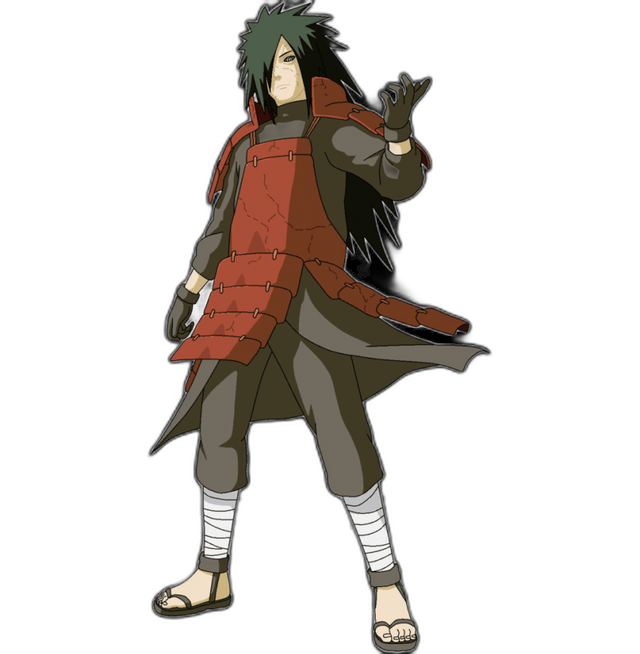
Co-founder of Konoha who awakened the Rinnegan. The strongest Uchiha of all time — fought the entire Allied Shinobi Forces alone.
Legendary Uchiha / Founder · Co-founder of Konoha who awakened the Rinnegan.
Co-founder of Konoha who awakened the Rinnegan. The strongest Uchiha of all time — fought the entire Allied Shinobi Forces alone.
Legendary Uchiha / Founder · Co-founder of Konoha who awakened the Rinnegan.
Madara Uchiha is the legendary co-founder of Konohagakure and the most powerful shinobi of his era. Born during the Warring States Period, Madara grew up on battlefields where children died before reaching adulthood. His partnership with Hashirama Senju ended centuries of clan warfare and established the first shinobi village system. But Madara's disillusionment with the peace they built led him down a path of singular ambition, transforming him from a village founder into the greatest threat the shinobi world had ever faced.
Madara's power reached heights that no other Uchiha attained. He awakened the Rinnegan by combining Uchiha and Senju chakra, controlled the Nine-Tails with his Sharingan, wielded a Perfect Susanoo that towered over mountains, and eventually became the Ten-Tails jinchuriki. His battle against the Allied Shinobi Forces during the Fourth Great Ninja War demonstrated a power gap so vast that the entire combined military of five nations could not slow him down. He alone fought thousands of shinobi, a feat that cemented his reputation as the strongest shinobi in history.
Madara's ultimate goal was to use the Infinite Tsukuyomi, a planetary genjutsu that would trap all humanity in an eternal dream. He believed this was the only way to end the cycle of war and suffering that had defined his life. Yet at the moment of his triumph, Madara was betrayed by Black Zetsu, who revealed that the Uchiha stone tablet had been tampered with to manipulate Madara into reviving Kaguya Otsutsuki. Destroyed by the very plan he had spent decades orchestrating, Madara died realizing he had been a pawn in a scheme millennia in the making. His story is a cautionary tale about power without purpose and vision without trust.
Madara Uchiha is a tall, muscular man with long, spiky black hair that frames his face and reaches down his back. He has sharp, defined facial features with a strong jawline and thin eyebrows. His most distinctive physical trait is his Sharingan, which progresses from red tomoe patterns to the Mangekyo and finally to the Rinnegan with concentric purple rings. As a young man during the Warring States Period, Madara wore traditional Uchiha armor with a high-collared blue shirt, dark pants, and armored greaves. His hair was shorter and his expression carried the intensity of a warrior who had never known peace.
In his prime as Konoha's co-founder, Madara donned the standard Uchiha outfit of a dark blue high-collared shirt with the clan crest on the back, red armor plating over his chest and shoulders, and a crimson war fan known as the Gunbai on his back. This fan, marked with the Uchiha crest in black, was both a symbol of authority and a weapon capable of deflecting jutsu. His appearance during this period exuded the aura of a leader who had built a village from nothing and would defend it through any means necessary.
After being resurrected through Edo Tensei during the Fourth Great Ninja War, Madara appears with the cracked, discolored skin of the reanimation jutsu. His armor is replaced with a deep red samurai-style chest plate over a black kimono, with segmented shoulder guards and layered leg armor. His hair is longer and wilder, and his eyes glow with the full power of the Rinnegan. In his final form as the Ten-Tails jinchuriki, Madara becomes a ghostly white figure with six magatama markings on his chest, horns protruding from his forehead, a complete Rinnegan pattern in each eye, and a Truth-Seeking Orb floating behind his back. This godlike transformation represents the ultimate evolution of his power, shedding all humanity for divinity.
Madara's personality is defined by a fierce pride in his Uchiha heritage and a profound disillusionment with the world. He grew up watching his siblings die in clan wars, including the loss of his brother Izuna, whose eyes he took to awaken the Eternal Mangekyo. These experiences taught him that the world was fundamentally broken and that peace built on compromise was an illusion. He carried the scars of every loss into his adulthood, hardening his conviction that only total control could prevent further suffering. His pride in the Uchiha name and his own power was not arrogance born of ignorance but confidence forged through ceaseless battle.
Madara's intelligence was matched only by his patience. After his defeat by Hashirama at the Valley of the End, he faked his death and spent decades in hiding, secretly manipulating events from the shadows. He groomed Obito Uchiha as his successor, created the Akatsuki as a front for collecting tailed beasts, reverse-engineered the secrets of the Rinnegan, and orchestrated a world war that would free the Ten-Tails. This long-term planning shows a mind capable of thinking in generational timescales. Madara did not merely react to events; he shaped the course of shinobi history for nearly a century after his supposed death.
A often overlooked aspect of Madara's psychology is his deep, conflicted friendship with Hashirama Senju. Hashirama was the only person Madara ever considered an equal, and their bond was genuine. Madara's decision to found Konoha with Hashirama came from a place of hope, but that hope curdled into bitterness when the village he helped build rejected the Uchiha. He felt betrayed not just by the political system but by Hashirama personally for failing to protect the Uchiha clan's position. This personal sense of betrayal made his turn to villainy more tragic. His final words about Hashirama reveal that even at the end, his former friend remained the standard by which he measured everything.
In combat, Madara's personality shifts to a calculated predator who toys with opponents before finishing them. He famously declared to the Allied Forces, "Do you want these clones to use Susanoo or not?" and responded to the Five Kage with mockery and contempt. But his combat arrogance had purpose: he wanted to break the enemy's will before their bodies. Madara understood that psychological defeat often preceded physical defeat. Despite his arrogance, he showed moments of respect for strong opponents, acknowledging Might Guy's Eight Gates as the strongest taijutsu he had ever faced and sparing his life out of admiration.
Madara awakened his Sharingan as a child on the battlefield and developed it into the Mangekyo after his friend's death. After transplanting his brother Izuna's eyes, he gained the Eternal Mangekyo, which removed the blindness that normally accompanied Mangekyo overuse. His Mangekyo abilities include the Great Fire Annihilation and the ability to summon and control the Nine-Tails with a mere glance. The Eternal Mangekyo granted Madara the stamina to use Susanoo for extended periods without the physical degradation that afflicted other Uchiha.
Madara's Susanoo is the most powerful version ever displayed. The Perfect Susanoo manifests as an enormous ethereal warrior, blue in color, that towers over mountains and can cut entire mountain ranges in half with a single sword swing. Its speed and power are so immense that it matched Hashirama's Wood Golem technique blow for blow. Madara could summon the Perfect Susanoo even while using other techniques, creating a two-handed assault system where he controlled the Susanoo while casting independent jutsu. During the war arc, his Susanoo alone devastated entire divisions of the Allied Shinobi Forces.
Madara awakened the Rinnegan after implanting Hashirama's flesh and spending decades cultivating the combined chakra. The Rinnegan granted him mastery over all six paths of Pain techniques, including planetary devastation (Chibaku Tensei), the ability to summon the Demonic Statue of the Outer Path, and the capacity to absorb any ninjutsu. His unique Rinnegan ability, Limbo: Border Jail, creates invisible copies of himself in a parallel dimension that can interact with the physical world. Only those with Six Paths Sage power or Rinnegan could perceive these clones, making them seemingly unavoidable attacks.
After incorporating Hashirama's cells into his body, Madara gained the ability to use Wood Style, a kekkei genkai previously exclusive to Hashirama. He used this to create massive forests, bind opponents, and construct the underground cavern where he kept the Demonic Statue. His mastery of Wood Style was refined enough to create the flowering tree that would eventually bloom into the Infinite Tsukuyomi, a technique that required precise chakra control across the entire planet.
Madara's ultimate form came when he absorbed the Ten-Tails and became its jinchuriki. This transformation granted him godlike abilities: flight, Truth-Seeking Orbs that nullify all ninjutsu, superhuman strength and speed, the ability to create and control life, and near-invulnerability. He could regenerate from most wounds instantly and had access to the Six Paths Sage power, including the ability to use all five nature transformations simultaneously. In this form, Madara was functionally unbeatable by any conventional means, requiring the combined efforts of Naruto, Sasuke, Obito, and Black Zetsu's betrayal to be stopped.
Madara's signature weapon, the Gunbai, is a large war fan capable of deflecting ninjutsu and generating powerful gusts of wind. He wielded it with one hand while maintaining hand seals with the other, demonstrating his ability to multitask at the highest level. His taijutsu was peerless, matching the physically strongest characters in the series. During the war arc, he fought the entire Five Kage simultaneously while standing still in his Susanoo, then dismantled them with contemptuous ease when he decided to engage personally.
Madara and his younger brother Izuna grew up in an era where Uchiha and Senju clans were locked in perpetual warfare. They lost three brothers to the conflict before Madara met Hashirama Senju at a riverbank where they forged a friendship based on shared dreams of peace. This alliance eventually ended generations of bloodshed and led to the founding of Konohagakure. Madara's decision to trust Hashirama and merge their clans was the most hopeful act of his life, and the betrayal he felt when that trust was not fully reciprocated set his entire tragic trajectory in motion.
After Konoha's founding, the Senju were given the Hokage position while the Uchiha were pushed into the village's military police, a role that isolated them from the community. Madara saw this as a betrayal of the equal partnership he had envisioned. He confronted Hashirama and demanded to become Hokage or see reforms, but the system had already been established. Feeling cornered and believing the Uchiha would never be treated fairly, Madara attempted to use the Nine-Tails against Konoha. Hashirama met him at the Valley of the End in a battle that carved the valley's geography, ending with Hashirama's victory.
Madara faked his death using a Sharingan genjutsu and a Shadow Clone during the Valley of the End battle. He went into hiding, implanting Hashirama's flesh into his wounds to eventually awaken the Rinnegan. As an elderly man, he saved a young Obito Uchiha from a rockslide and manipulated him into becoming his successor. He groomed Obito to believe in the Eye of the Moon Plan, created the Akatsuki to execute the collection of tailed beasts, and waited decades for the Rinnegan to fully mature. Madara's influence operated through proxies and manipulations, never revealing his continued existence until the war arc.
Kabuto resurrected Madara through Edo Tensei, unleashing him on the Allied Shinobi Forces. Madara immediately demonstrated his overwhelming power, easily repelling Naruto's Rasenshuriken, dodging attacks from the Raikage, and summoning a meteor from the sky to devastate the battlefield. He fought the Five Kage simultaneously, defeated them without serious effort, and demonstrated his Perfect Susanoo in its full glory. After being revived in his original body through Obito's Rinne Rebirth, Madara achieved the Ten-Tails jinchuriki transformation and became the most powerful being in the shinobi world.
Madara achieved everything he had worked for: he became the Ten-Tails jinchuriki, cast the Infinite Tsukuyomi, and believed he had created a world of eternal peace. Then Black Zetsu, whom Madara believed was his will made manifest, stabbed him through the chest and began the process of reviving Kaguya Otsutsuki. Black Zetsu revealed that the Uchiha stone tablet had been modified over centuries, that Infinite Tsukuyomi was designed to resurrect Kaguya, and that Madara had been a pawn from birth. In his final moments, Madara realized that his entire existence had been orchestrated by an ancient entity using the rivalry between Indra and Asura as a blueprint. His ego, pride, and decades of planning all collapsed in an instant.
The single most significant relationship in Madara's life. Hashirama was the only person Madara ever respected as an equal. Their childhood friendship at the riverbank, where they skipped stones and dreamed of a village where children would not have to fight, was the foundation of everything Madara hoped for. When that dream fractured, Hashirama became the embodiment of everything Madara despised about the system they built. Yet even in his final moments, Madara's thoughts returned to Hashirama, showing that their bond never truly broke. Hashirama's death before the events of the main series left Madara as the sole living legend of their era, amplifying his loneliness and conviction.
Izuna was Madara's only surviving sibling after years of war. He was a prodigy Uchiha who awakened his own Mangekyo Sharingan and fought alongside Madara against the Senju. After being gravely wounded by Tobirama Senju, Izuna willingly gave his eyes to Madara, allowing him to awaken the Eternal Mangekyo. Izuna's death was the final emotional blow that pushed Madara toward his darker path. The guilt of taking his brother's eyes and the weight of being the sole bearer of the Uchiha legacy shaped Madara's conviction that he must carry the clan's destiny alone.
Madara found Obito crushed under a boulder, broken in body and spirit, and rebuilt him into a weapon. He manipulated Obito by orchestrating Rin's death through the Three-Tails' seal, ensuring Obito would see the worst of the world. Madara trained Obito, taught him the Eye of the Moon Plan, and used him as a proxy while waiting for the Rinnegan to mature. However, Madara underestimated Obito's will. Obito eventually defied Madara's plans by choosing his own path, siding with Naruto and helping to stop Madara at a critical moment. Their relationship was a master-student dynamic twisted into pure exploitation.
Madara believed Black Zetsu was his will incarnate, an extension of his own consciousness that he created from the Demonic Statue. In truth, Black Zetsu was the physical manifestation of Kaguya Otsutsuki's will, a being that had manipulated the Uchiha bloodline for millennia. Black Zetsu guided Madara's entire journey, ensuring he would follow the path to revive Kaguya. At the moment of Madara's greatest triumph, Black Zetsu struck him down, stole his power, and used him as a vessel for Kaguya's resurrection. This is the most devastating act of betrayal in the series, reducing Madara's grand ambition to a manipulated script.
Tobirama, Hashirama's younger brother, was Madara's political adversary. Tobirama distrusted the Uchiha clan and designed the military police system that isolated them from village leadership. Madara blamed Tobirama for the Uchiha's marginalization and viewed him as the architect of the system that betrayed the original vision of Konoha. Their ideological conflict extended beyond their lifetimes, as Tobirama's policies toward the Uchiha directly contributed to the conditions that led to Itachi's massacre generations later.
Madara never met Hagoromo directly but was obsessed with surpassing him. As the reincarnation of Indra, Madara was part of the spiritual legacy of the Sage of Six Paths. By awakening the Rinnegan and becoming the Ten-Tails jinchuriki, Madara achieved a power level comparable to Hagoromo himself. However, Hagoromo's chakra appeared during the war arc to empower Naruto and Sasuke, directly opposing Madara's plans. The Sage of Six Paths represented the pinnacle Madara aspired to reach, making Hagoromo both his goal and his obstacle.
Madara Uchiha stands as the most iconic antagonists in anime history. His presence in the narrative shifted the power scale of the entire series, introducing a level of destruction and authority that redefined what readers believed was possible in the Naruto universe. The moment he casually dropped two meteors on the Allied Shinobi Forces is the most referenced scenes in anime discussions, spawning countless memes, reaction videos, and power scaling debates. Madara's line "Is that all?" after shrugging off combined attacks from multiple Kage-level shinobi became a catchphrase representing ultimate villain confidence.
Madara's design elements have influenced anime villain aesthetics for over a decade. The combination of long, wild hair, ancient armor, crimson war fan, and Rinnegan eyes created a visual template that many subsequent series have referenced. His Perfect Susanoo, a towering ethereal warrior of blue chakra, set the standard for what an ultimate technique should look like. Video game adaptations of Naruto frequently feature Madara as an unlockable boss character or playable fighter with the highest stats, reflecting his position at the top of the series' power hierarchy.
The character's philosophical underpinnings about the nature of peace, the cycle of hatred, and the impossibility of true understanding between people have been analyzed in academic essays and video essays. Madara's argument that the shinobi system is inherently flawed because it tries to create peace through force resonates with real-world political philosophy. His conversation with Hashirama about whether their dream of a peaceful village was worth the cost of creating it offers a critique of idealism versus pragmatism. These themes elevate Madara beyond a simple villain into a complex figure whose worldview challenges the protagonists' optimism.
Madara's popularity is reflected in merchandise sales, with action figures, statues, and apparel featuring his design consistently among the best-selling Naruto products. His character has been voiced by Naoya Uchida in Japanese and Neil Kaplan in English, both of whom delivered performances that captured Madara's mixture of ancient gravitas and predatory menace. Even among casual anime fans who have not watched Naruto to completion, Madara is recognized as a symbol of overwhelming antagonist power. His legacy as the "strongest Uchiha" remains unchallenged within the fandom, and his betrayal by Black Zetsu is frequently cited as the most controversial yet narratively fitting endings for a character who could only be stopped by deception, not force.
Madara awakened the Rinnegan near the end of his natural lifespan by combining Indra's and Asura's chakra. After his battle with Hashirama at the Valley of the End, Madara took a piece of Hashirama's flesh and grafted it into his own wound. Over decades, the combination of Uchiha and Senju chakra within his body awakened the Rinnegan, the dojutsu of the Sage of Six Paths.
No, Hashirama Senju defeated Madara in their final battle at the Valley of the End. Hashirama's Wood Style and Sage Mode gave him the edge over Madara's Perfect Susanoo and Nine-Tails control. However, Madara with Hashirama cells, the Rinnegan, and Ten-Tails power surpassed Hashirama. Madara himself acknowledged Hashirama as the only shinobi who could truly defeat him.
Limbo: Border Jail is Madara's unique Rinnegan ability that creates invisible, intangible duplicates of himself in a parallel dimension. These clones exist in the same physical space as the real world but cannot be seen, sensed, or touched by anyone except those with Six Paths Sage power or Rinnegan. Madara used Limbo to overwhelm Naruto and Sasuke simultaneously, fighting them on multiple dimensions at once.
Madara lost faith in the possibility of lasting peace after seeing constant war and betrayal. After his brother Izuna's death and his disillusionment with Konoha, he concluded that the only way to end human suffering was to place all humanity under Infinite Tsukuyomi, a world-encompassing genjutsu that traps everyone in a perfect dream. He believed this was salvation, not tyranny, and that he was the savior destined to unite the world.
No. Madara achieved the Ten-Tails jinchuriki transformation and cast Infinite Tsukuyomi, but he was betrayed at the final moment by Black Zetsu, who revealed that everything Madara believed about the Uchiha stone tablet was a manipulated lie designed to revive Kaguya Otsutsuki. Madara died realizing he had been a pawn his entire life, manipulated by a force far older than the shinobi world.