Kabuto Yakushi was a triple-agent spy, a medical prodigy, and a supremely dangerous shinobi in the Naruto world. Orphaned by war and raised by Root, he lost his identity and found a new one serving Orochimaru. After his master's death, Kabuto absorbed Orochimaru's remains and achieved Snake Sage Mode, mastering the Edo Tensei on a scale never before seen. He commanded the undead army of the Fourth Great Ninja War until Itachi Uchiha trapped him in the Izanami genjutsu, forcing him to confront his true self. After the war, he chose redemption as the director of Konoha's orphanage.
Overview
Kabuto was discovered as an infant on a battlefield by an elderly nun named Nono Yakushi, who raised him at the Konoha orphanage. He was recruited into Root — Danzo Shimura's secret black ops division — where he was trained as a spy and infiltrator. His cover was a simple medical-nin in Konoha, a role he played so convincingly that even his fellow shinobi never suspected his true allegiances.
During the Chunnin Exams arc, Kabuto posed as a genin examinee while feeding information to Orochimaru about Sasuke Uchiha and the Sand-Sound invasion plan. After the exams, he defected openly to join Orochimaru, serving as his right hand in experiments, intelligence operations, and medical research. He became Orochimaru's most trusted subordinate, managing the Sound Village's spy network and assisting in the pursuit of Sasuke.
When Orochimaru was absorbed by Sasuke during the latter's battle with Itachi, Kabuto faced an identity crisis. He had defined himself through Orochimaru — without his master, he did not know who he was. His solution was to literally become Orochimaru by absorbing his remains, grafting Orochimaru's cells and DNA into his own body. This transformation gave him access to Orochimaru's knowledge, techniques, and eventually Sage Mode from Ryuchi Cave, making him a threat on par with the series' strongest characters.
Appearance
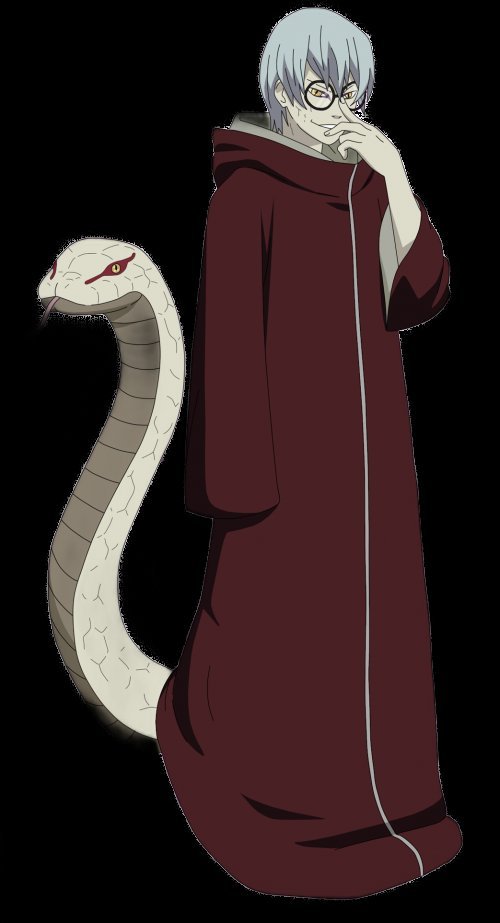
Kabuto's appearance evolved dramatically over the series. In his early years, he had silver-white hair, pale skin, and distinctive round glasses that gave him an unassuming, scholarly look. He wore the standard Konoha chunin vest and a gray outfit, deliberately appearing harmless and non-threatening. His neutral expression and soft-spoken demeanor made him easy to overlook — exactly as Root had trained him.
After absorbing Orochimaru's remains, Kabuto's appearance shifted to reflect his new power. His skin took on a grayish pallor, his silver hair grew longer and wilder, and his face elongated to resemble Orochimaru's serpentine features. He stripped off the Konoha vest and wore a sleeveless dark outfit with a high collar, revealing his heavily modified body covered in scale-like patterns and snake-like textures.
In his Snake Sage Mode, Kabuto underwent a far more dramatic transformation. Large, curved horns grew from his head, his eyes turned into vertical snake pupils with yellow irises, and his lower body transformed into a massive white snake tail. Scales spread across his torso and arms, and his voice developed a layered, echoing quality. This form gave him an almost demonic appearance — a hybrid of man, snake, and Orochimaru's lingering influence.
Personality
Kabuto's defining trait was his lack of a stable identity. Root had trained him from childhood to be a tool — a spy who wore masks so often that he forgot what his real face looked like. He was capable of mimicking any personality convincingly: the helpful medic, the ambitious student, the loyal subordinate, the ruthless experimenter. But underneath these masks was a void where a genuine self should have been.
His obsession with Orochimaru stemmed from this identity crisis. Orochimaru was everything Kabuto felt he could never be — a person who pursued his own goals without caring about external validation. By serving and later absorbing Orochimaru, Kabuto believed he could claim that identity for himself. He started dressing like Orochimaru, speaking like him, and even adopting his mannerisms and laugh. This was not admiration so much as desperate self-invention.
After achieving Sage Mode, Kabuto developed a god complex. He believed that by surpassing Orochimaru, he had transcended the limits of ordinary shinobi and become something more. He referred to himself as the one who would "become the world" and viewed the Fourth Great Ninja War as his stage. Itachi's Izanami shattered this delusion by forcing Kabuto to relive his identity crisis until he acknowledged the truth: he had been running from himself his entire life. His eventual acceptance led to genuine redemption and, finally, a stable identity as a caretaker and healer.
Abilities
Medical Ninjutsu: Kabuto was a certified medical prodigy who surpassed most of Konoha's veteran medics before the age of twenty. He could perform field surgery under combat conditions, heal severe injuries with precise chakra control, and use the chakra scalpel technique to dissect targets at the cellular level. His medical knowledge also extended to genetic modification, which he used to experiment on himself and others.
Snake Sage Mode: Kabuto achieved Sage Mode at Ryuchi Cave, the domain of the White Snake Sage. His version of Sage Mode was unique — he used Juugo's DNA to stabilize the senjutsu chakra, allowing him to maintain the form indefinitely without petrifying. In this state, he gained access to Inorganic Reincarnation (turning any inorganic material into a weapon), White Snake Possession (shedding his skin to escape attacks), and the ability to sense chakra across vast distances.
Edo Tensei (Impure World Reincarnation): Kabuto's mastery of Edo Tensei was unprecedented. He summoned approximately 50-60 revived shinobi simultaneously, including Akatsuki members (Itachi, Nagato, Sasori, Deidara), past Kage (Tobirama, Hashirama, the Second Tsuchikage, the Third Kazekage, the Fourth Mizukage), legendary figures, and Madara Uchiha — who alone required every ounce of Kabuto's control. He experimented with the technique to give certain summons unique modifications, such as removing Itachi's will entirely.
In addition to these core abilities, Kabuto had assimilated DNA from multiple powerful shinobi, giving him access to various techniques. He could use Sakon and Ukon's body-merging ability, Kidomaru's spider web production, Jirobo's chakra absorption, Tayuya's genjutsu, and Kimimaro's bone manipulation. This genetic variety made him unpredictable in combat and extremely difficult to counter.
Story Arcs
Root Orphan and Spy: Kabuto was found as an infant on a battlefield by Nono Yakushi, the caretaker of Konoha's orphanage. He was recruited by Root and trained as a spy from childhood. His first major mission was infiltrating the Chunnin Exams as a genin-level examinee while secretly working for Orochimaru. During this time, he also posed as a loyal Konoha medic, building trust with senior shinobi while leaking intelligence to the Sound Village.
Serving Orochimaru: After the Konoha Crush, Kabuto joined Orochimaru openly. He managed the spy network across multiple hidden villages, conducted experiments on captured shinobi, and assisted in developing cursed seals and genetic modifications. He was instrumental in tracking Sasuke's development and reporting his progress to Orochimaru. During the search for Tsunade, Kabuto fought against Naruto and Shizune, showcasing his medical combat skills.
Absorption and Transformation: Following Orochimaru's death at Sasuke's hands during the Itachi Pursuit Arc, Kabuto entered a period of crisis. He retrieved Orochimaru's remains from Sasuke's lair and absorbed them into his own body. He then traveled to Ryuchi Cave to master Sage Mode, using Juugo's DNA as a stabilizer. This period transformed him from a support character into a major antagonist with power on par with the series' elite.
Fourth Great Ninja War — Edo Tensei Army: Kabuto allied with Tobi (Obito) and offered his Edo Tensei army as the foundation of the war effort. He summoned dozens of deceased shinobi across multiple battlefields, forcing the Allied Shinobi Forces to fight their own legends. His crowning achievement was summoning Madara Uchiha, who alone required constant concentration to maintain control. Kabuto fought against Itachi and Sasuke in a cave beneath the battlefield, where Itachi unleashed the Izanami.
Redemption: The Izanami trapped Kabuto in an infinite loop of his own memories, forcing him to confront his identity crisis and recognize his true self. After the war ended, he was released from the genjutsu and chose to change. He returned to Konoha, was pardoned for his crimes, and dedicated himself to running the orphanage where he had grown up — finally becoming the person Nono Yakushi had believed he could be.
Relationships
Orochimaru: Kabuto's idol, master, and template for his stolen identity. He served Orochimaru loyally for years, managing experiments and intelligence. After Orochimaru's death, Kabuto absorbed his remains to claim his power and identity. Despite this, Orochimaru himself viewed Kabuto as a useful but disposable tool — a harsh truth Kabuto never fully acknowledged until the Izanami forced him to see it.
Nono Yakushi: The orphanage caretaker who raised Kabuto and gave him his name. She was the closest thing to a mother he ever had. After she was killed by Root operatives (a truth Kabuto learned later), he suppressed the trauma and buried his emotions. Her memory became the key that unlocked the Izanami's lesson — that he had always known who he was, he just refused to accept it.
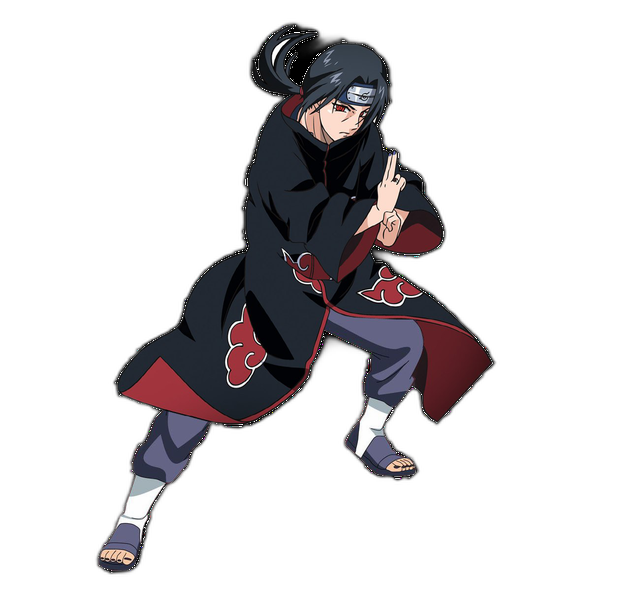
Itachi Uchiha: Kabuto's direct opponent in the war arc and the one who finally defeated him. Itachi analyzed Kabuto's identity crisis during their battle and used Izanami to force him to confront it. Their fight was a psychological battle as much as a physical one — Itachi's calm, self-assured philosophy clashed directly with Kabuto's fractured sense of self.
Sasuke Uchiha: Kabuto had a complicated history with Sasuke. During the Chunnin Exams, he posed as a helpful senpai and provided Sasuke with medical treatment. After joining Orochimaru, he monitored Sasuke's training and tried to steer him toward Orochimaru's goals. In the war, he viewed Sasuke as a target but was finally defeated by the combined efforts of Sasuke and Itachi.
Cultural Impact
Kabuto's evolution from a background character to the mastermind behind the Edo Tensei army is a significant character arc in Naruto's final saga. He represented a theme central to the series — the search for identity in a world that tries to define you by your function. His line about collecting cards and realizing he had left the most important card blank resonated with many viewers who understood the feeling of not knowing who they truly were.
His mastery of Edo Tensei transformed the Fourth Great Ninja War from a conventional army battle into a nostalgic parade of fallen heroes and villains. The revival of past Kage, Akatsuki members, and legendary figures created some of the most emotional moments in the series. Madara Uchiha's return, in particular, became a defining sequence of the war arc, and it was Kabuto's technique that made it possible.
Kabuto's Snake Sage Mode design is widely praised for its creativity. The white snake body, curved horns, and serpentine features gave him a distinct visual identity separate from Orochimaru's snake aesthetics. His battle against Itachi and Sasuke in the cave is remembered as one of the series' most creative fights, combining psychological warfare with unique abilities like Inorganic Reincarnation and the Izanami trap.
His redemption arc, while divisive among fans, completed his character journey in a way that aligned with Naruto's core themes. The boy who had no identity found one not by becoming someone else, but by accepting who he had always been — a caretaker and healer who helped others find their way. His post-war role as the orphanage director gave him a peaceful ending that felt earned despite his wartime atrocities.
Frequently Asked Questions
What happened to Kabuto Yakushi in Naruto?
Kabuto began as a Root orphan and spy, served Orochimaru for years, and after Orochimaru's death absorbed his remains to gain power. He achieved Snake Sage Mode and summoned an army of Edo Tensei during the Fourth Great Ninja War. Itachi Uchiha trapped him in the Izanami genjutsu, forcing him to confront his identity crisis. After the war, Kabuto redeemed himself by running the Konoha orphanage.
How did Kabuto get Sage Mode?
Kabuto achieved Sage Mode by absorbing Orochimaru's remains, which gave him the snake-based chakra needed to access Ryuchi Cave's sage energy. He took Juugo's DNA to stabilize the senjutsu chakra within his body, allowing him to maintain the transformation without petrifying. His Sage Mode granted him horns, snake-like features, and access to unique techniques like Inorganic Reincarnation.
How many Edo Tensei did Kabuto control?
During the Fourth Great Ninja War, Kabuto summoned approximately 50-60 Edo Tensei revived shinobi, including past Kage, Akatsuki members, Jinchuriki, and legendary figures like Madara Uchiha. This was by far the largest-scale use of the Impure World Reincarnation technique in history. His precise chakra control allowed him to manage multiple high-accuracy summons simultaneously.
Did Kabuto survive the Fourth Great Ninja War?
Yes, Kabuto survived. After being trapped in Itachi's Izanami, he was released when he genuinely acknowledged his past and chose to change. Following the war, he was pardoned and returned to Konoha, where he took over as director of the city's orphanage. He also helped restore Sasuke's health after the final battle by providing him with medical treatment.
Why did Kabuto idolize Orochimaru?
Kabuto was an orphan recruited into Root who lost his identity as a tool of the organization. When he met Orochimaru, he saw a shinobi who pursued power and knowledge without caring about others' approval — everything Kabuto felt he could never be. He adopted Orochimaru's mannerisms and goals as a substitute identity, believing that by becoming Orochimaru, he could finally have a true sense of self.